Shepsie Tirschwell
The Plot Against AmericaShepsie Tirschwell is a projectionist at Newark’s Newsreel Theater and a boyhood friend of Herman Roth. Through years spent watching unedited footage from around the world, he comes to believe that the political danger in the United States is not a passing crisis but the opening stage of a larger totalitarian project. He acts on that conviction by arranging to take his family to Winnipeg, giving his warning a personal cost: safety means leaving his native city, his friends, and the theater where he has made his living.
Identity and the newsreel booth
Shepsie’s work places him behind the screen, in a projection booth that becomes both a literal workplace and a vantage point on events elsewhere. The film is not, for him, merely entertainment or a sequence of distant images. He has watched raw, unedited material from newsreel crews over several years, and what he sees has convinced him that the public spectacle of political power conceals a far more threatening design. His authority in the story comes not from an official position but from sustained attention to images other people may choose to watch without drawing the same conclusions.
When Herman visits after a screening of the White House dinner, Shepsie tells him that he and his family will leave for Winnipeg on June 1. The announcement reaches Herman through a private conversation in the projection booth, rather than through a public declaration. The intimacy of that setting suits the news: this is not an abstract forecast alone, but a friend’s decision to uproot an entire household.
Departure for Winnipeg
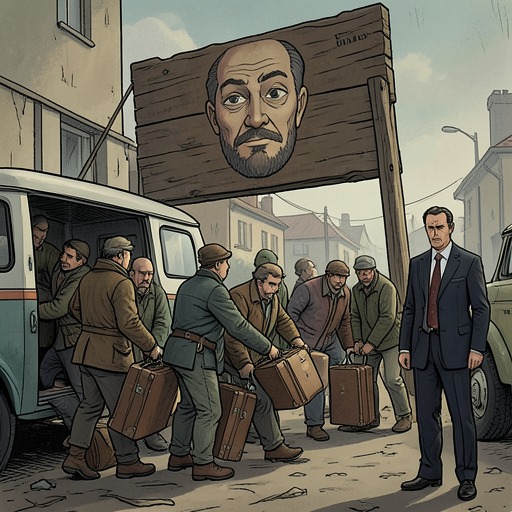
The move involves Shepsie’s wife, their three children, his mother, and his wife’s elderly parents. Representatives of Winnipeg’s small Jewish community have helped him find work as a projectionist in a neighborhood movie house and have located apartments for the family in a modest Jewish neighborhood resembling their own. They have also arranged a low-interest loan to cover the move from the United States and help support the in-laws until his wife finds work and can contribute to their living expenses. The arrangements are practical and collective: the family’s escape depends not on a solitary journey but on employment, housing, credit, and care for older relatives being organized in advance.
Shepsie does not present departure as easy or welcome. He hates parting from his native city and dear old friends, and regrets leaving his distinctive job at what he regards as Newark’s most important theater. There is much to abandon, but the prospect of staying seems more dangerous. Since Charles A. Lindbergh’s inauguration a year and a half earlier, only an estimated two to three hundred Jewish families have established permanent residence in Canada. The Tirschwells are the first such fugitives Herman personally knows. Their departure makes the threat tangible to him, even as he decides to withhold the news from his family, fearing it will terrify Philip, anger Sandy, and prompt Bess to demand immediate emigration.
A forecast of the political future
Shepsie’s explanation to Herman is starkly specific. He believes the secret side of the 1941 Iceland pact between Charles A. Lindbergh and Adolf Hitler provides for Hitler to defeat the Soviet Union, then invade and conquer England. In his forecast, Japan would overrun China, India, and Australia, completing a new order in East Asia. Only afterward, he predicts, would the American president establish an “American Fascist New Order,” a dictatorship modeled on Hitler’s, before a final German campaign to conquer and Nazify South America.
He extends the forecast roughly two years into the future: the swastika flying over London’s Parliament, the Rising Sun over Sydney, New Delhi, and Peking, and Lindbergh reelected for another four years. Then, Shepsie believes, the border with Canada would close, diplomatic relations between the countries would end, and a mass assault would begin against the United States’ four and a half million Jews, with constitutional rights curtailed in the name of an internal emergency. These are Shepsie’s predictions, not events the narrative establishes as having occurred. Their importance lies in the way he connects international conquest, domestic dictatorship, and the vulnerability of American Jews into one unfolding danger.
The White House dinner film has sharpened his alarm. Shepsie has seen Joachim von Ribbentrop and his wife warmly greeted on the White House portico by the president and Anne Morrow Lindbergh, followed by prominent guests arriving with apparent anticipation of dining and dancing with the Nazi official. Among them are Lionel Bengelsdorf and Evelyn Finkel, whose visible pleasure at the occasion appalls Herman. The film’s images make the political alliance look not remote but socially accepted, performed amid smiles and ceremony. Shepsie’s prediction is much more pessimistic than Herman’s own, and the friend’s decision to leave shakes him.
The child at the booth
Shepsie’s political alarm also shapes his encounter with Philip. At the soundproof booth door, he lets the boy in while holding a note from Sister Mary Catherine, and says that he cannot avoid showing it to Philip’s parents. Later, when Philip cries after Shepsie expresses disdain for Aunt Evelyn, Shepsie responds with bitter impatience. He asks whether the child understands what people around the world are suffering and hopes he will be spared a real reason to cry. He breaks off before finishing his warning about Philip’s family, then hands him a handkerchief and tells him to dry his eyes.
The scene does not make Shepsie’s harshness simple kindness: Philip recognizes that the anger is directed at something larger than himself, but still bears its force. The contrast is revealing. To the child, the immediate injury is being denied a visit to his aunt; to Shepsie, that distress seems painfully small beside the danger he has been watching approach. The booth, where distant crises arrive as moving images, becomes the place where those different scales of fear collide.
Departure as warning
At the end of May, Shepsie and Estelle are among the guests at a confidential gathering in the Roths’ living room for Jewish insurance agents being relocated under Homestead 42. They are only days from moving their family to Winnipeg. Their presence connects the planned departure to the other families facing relocation, while their own choice of Canada marks a different response to the political climate: leaving the country rather than accepting a new assigned home within it.
Shepsie is neither shown as an official leader nor given a confirmed later fate. His role is that of a witness whose reading of newsreel images leads to a consequential private decision. The move costs him a valued job and a home among old friends, while the support arranged in Winnipeg offers a concrete alternative for the family he is trying to protect. His warning remains a forecast, but the departure itself is already real; in that gap between anticipated catastrophe and present loss, the novel gives political fear the shape of a family preparing to leave.